York
The city of York was founded by the Romans in A.D.71 and called Eboracum. Constantine the Great was declared Emperor in A.D. 306 by his soldiers based in the fortress. It was conquered by the Danes in A.D. 866 and became a major port under Viking control. It was renamed Jόrvík which was eventually shortened to York by the 13th century. York was ravaged by William the Conqueror’s army in 1068 in the harrying of the North. York is associated with many famous and infamous names such as Guy Fawkes who was born and educated here. The highwayman Dick Turpin was tried and executed in 1739. In 1644, during the Civil War, York was besieged by the Parliamentarian army. Prince Rupert’s supporters relieved the city only to be defeated at the Battle of Marston Moor. By the late 1800s York had become a major railway centre.


Scarborough
The coastal town of Scarborough is historically part of the North Riding of Yorkshire. It is home to a large fishing industry and also the largest holiday resort on the North East coast. The 12th century castle has been the site of many battles over the years; during the Civil War the castle passed between the Parliamentarians and the Royalists seven times. From the 1650s the castle was used as a prison, George Fox, founder of the Quakers, was held there in 1665 for his outspoken religious beliefs. During the Napoleonic War French captives were imprisoned in the castle. In December 1914 the castle was bombarded by German warships and severely damaged by the shells aimed at the town.


Whitby
Whitby, which lies at the mouth of the River Esk, is synonymous with Bram Stoker who took inspiration from the town for his epic novel ‘Dracula’. The atmospheric Whitby Abbey, once home to St. Hilda, dominates the East Cliff whilst the ‘Whale Jaw Bones’ atop of the West Cliff pays homage to the town’s whaling history. Originally Whitby lay within the Kingdom of Northumbria and was the site of an Anglo-Saxon abbey which was founded in 657 A.D. In 664 A.D. the abbey became the setting for the Synod of Whitby which was an important meeting, chaired by the Northumbrian king, to decide if the people should follow the Celtic or Roman teachings of Christianity; St Aiden’s Celtic Christianity was abandoned in favour of Roman Catholicism. The abbey was destroyed during the Viking raids in 870 A.D. and later rebuilt by the Normans who dedicated the abbey to St Hilda a Northumbrian princess, who became the first abbess. Whitby derives its name from the Viking Hviteby meaning ‘the White Town’. The names of many villages in the Esk valley are said to have Viking names, Eskdale, Ainthorpe, Danby and Goathland being examples. In more recent times Whitby is te most popuar place for Yorkshire landscape photography


Cleveland
To the north of Whitby lies an ancient district of Yorkshire named Cleveland which means cliff land. The coastal cliffs at Boulby are the highest on the eastern coast of England and their recesses once provided shelter for eighteenth century smugglers who were active in the area. It is believed that the Vikings made settlements along this stretch of coastline as many villages bear Viking names such as Skinningrove which means skinners’ pit; Carlin How which means witches’ hill; and Loftus which was a house with a loft.



Staithes
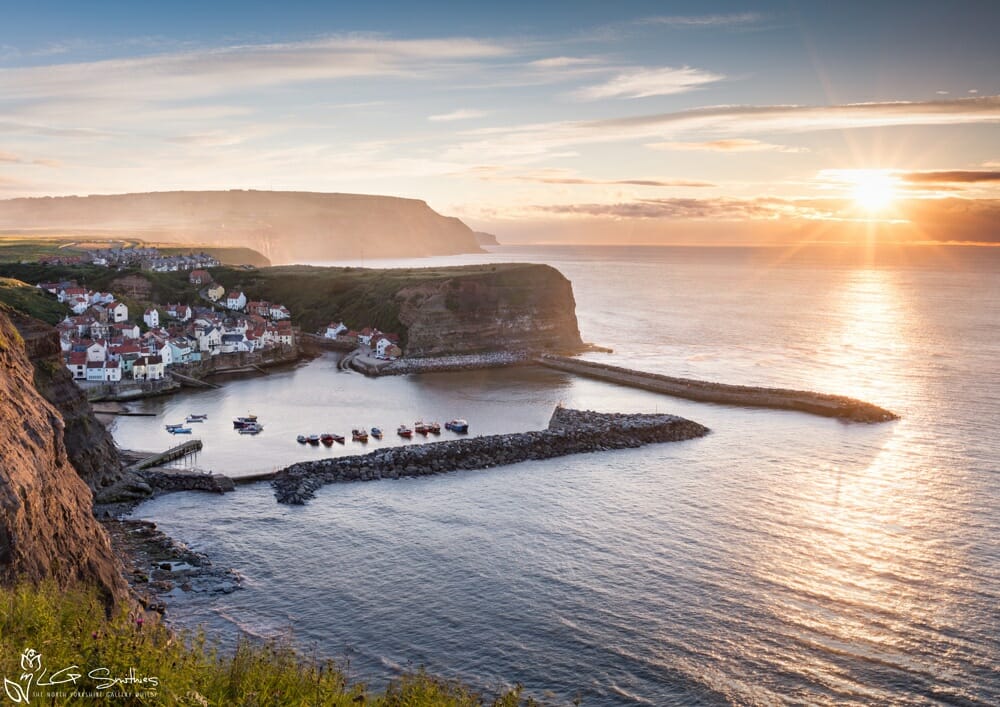
Staithes was also a Viking settlement with the name deriving from the landing place where the longboats came ashore. The picturesque village is now synonymous with the name of Captain Cook who as a young boy was an apprentice grocer here. It was while working in Staithes that his passion for sea faring adventures evolved. After working for a Whitby ship-owner he joined the navy and rapidly worked his way up the ranks and became a Captain. He discovered the new lands of Australia, New Zealand, Tahiti, Alaska and Hawaii before he died in 1779 after a disagreement between his crew and the indigenous people of Hawaii. Local tour guides still, incorrectly, tell visitors to the island that the place where Cook died is the only part of the United States which is still British territory.


Guisborough
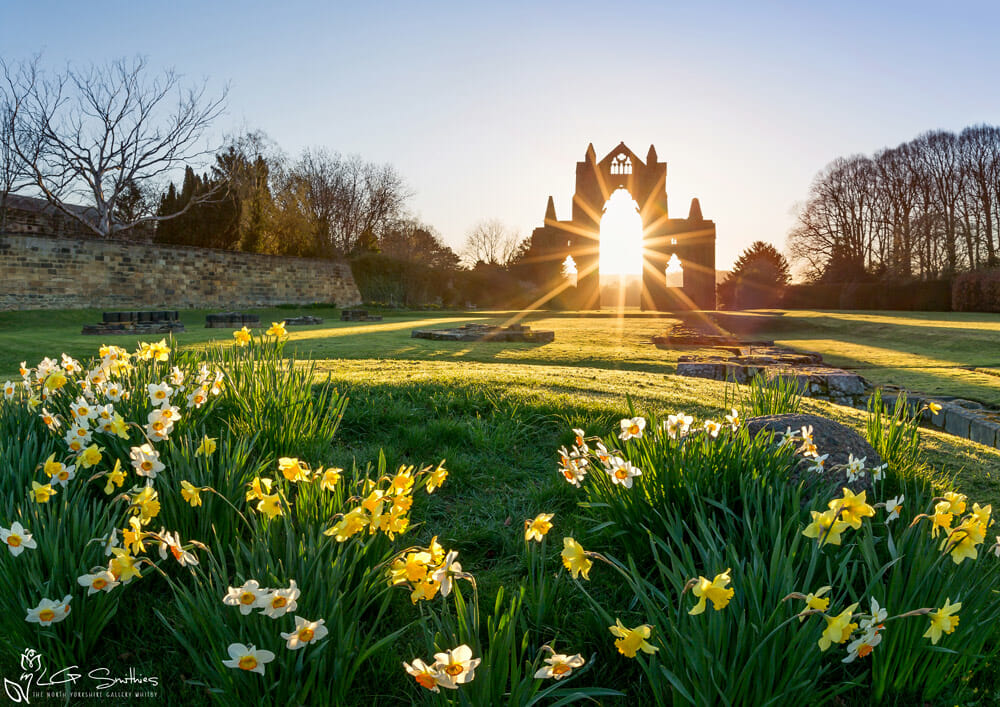
The market town of Guisborough was originally the capital of Cleveland. The most notable landmark is the Augustinian priory founded by the Bruce family who later became kings of Scotland. The priory was founded in 1119 but destroyed by fire in 1289. It was rebuilt in the Gothic style and took about one hundred years to complete. In 1536 Yorkshire was the setting of one of the most serious rebellions in Tudor times when Henry VIII declared himself to be the Supreme Head of the Church of England. All church lands, including the priory, became the property of the king. At this time it is estimated that five-hundred families relied on the priory for their livelihoods. The uprising known as the Pilgrimage of Grace was in protest against the dissolution of the monasteries, and social and economic policies in general. Guisborough priory was dissolved in 1540 and was one of the last in England to be suppressed.
Much of the area around Guisborough was known as Langbaurgh Ridge meaning long hill. It was once a Viking meeting place where Vikings met to discuss local issues. The Wappentakes, as they were known, continued well into the medieval period as administrative districts.
Between Guisborough and Marske lies the village of Upleatham where we find the tiny church St Andrew’s. This church is reputedly the smallest church in England measuring a mere 17 feet 9 inches by 13 feet.


Roseberry Topping
Roseberry Topping is one of Cleveland’s best known natural landmarks and can be clearly seen from many parts of rural Cleveland and industrial Teesside. Evidence was discovered proving that the Roseberry area had been occupied since the Bronze Age. Vikings settled in this area from early medieval times and gave it the name Odins-Beorge which means Odin’s hill. The name changed over the years to Othensberg, Ohenseberg, Ounsberry, Onsberry and finally Roseberry. It also referred to as the Cleveland Matterhorn and was used by sailors as an indication of weather conditions.


Redcar
The town of Redcar began as a small fishing village which developed into a coastal resort in the nineteenth century with the advent of the railways. Redcar still attracts day trippers to the seaside and also horse racing enthusiasts to the town’s race course. Redcar is also the home of the world’s oldest surviving lifeboat, the Zetland, which was built in South Shields. It was bought by local fishermen in 1802 and named after the local lord of the manor. In the summer of 2006 parts of the sea front were altered to recreate Dunkirk to shoot scenes for the film Atonement.


Saltburn
Saltburn was the site of one of the many fortified Roman signalling stations positioned along the Yorkshire coast to give advance warning of raids by Anglo-Saxons. The watchtower at nearby Huntcliff was overrun by invaders in the fourth century; the occupants were murdered and it is believed that the bodies were thrown down a nearby well.
From the 1700s Saltburn was part of the smuggling network that developed in the coastal villages down to Whitby. Outwitting the Excise men was a way of life and involved people of all social standings. John Andrews, Scottish landlord of the Ship Inn, was one of the better known smugglers. Goods could be secretly offloaded in the isolated coves and hiding contraband was a whole village affair. The design of the cottages enabled the booty to be moved from one home to the next without appearing above ground.
In Victorian times Saltburn became a holiday resort when the town became linked to the railway network in 1861.The railway extension was attributed to Henry Pease who was a coal mine owner’s son from Darlington. Henry Pease also was responsible for the building of the Zetland Hotel at the top of the bank, involved in the creation of the Italian Gardens (now referred to as the Valley Gardens), the inclined tramway (which is the oldest water balanced tramway still in use in Britain), and the pier which was originally 1400 feet long but today only 600 feet long.


Yorkshire Market Towns
North Yorkshire has many market towns which are steeped in history lie Knareborough and Bedale, which was awarded a Market Charter in 1251; Boroughbridge, the site of a battle in 1322 between King Edward II and his cousin the Earl of Lancaster; Easingwold, on the outskirts of the city of York; Filey, which was a small fishing village until it was connected to the railways in the Victorian era and then became another of the popular seaside resorts; Grassington, which was a lead mining centre in the 18th and 19th century; Hawes, famous for England’s highest single drop waterfall, Hardraw Force, and the Buttertubs Pass; Helmsley, where the remains of the 12th century castle can be seen, and is also the start of the Cleveland Way Walk; Knaresborough, where the Victorian viaduct spans the river, and also boasts the remains of a castle which was besieged by Parliamentarians during the Civil War. This town was also home to the legendary Mother Shipton who foretold events such as the English Civil War and the Fire of London; Pateley Bridge, twice winner of Britain in Bloom competition; Pickering, which is the terminus of the 18 mile North Yorkshire Moors Railway where passengers can travel by steam powered trains across the picturesque countryside to the village of Grosmont; Richmond, famous for its Norman castle which was constructed to protect Swaledale from marauding Scots. From the 17th century it became the centre of the wool industry; Ripon is home to a 12th century cathedral which has a Saxon crypt and is believed to be the oldest Christian survival in England; Settle which is the starting point of the scenic Settle to Carlisle railway; Skipton which is considered to be the Gateway to the Dales, is divided by the Leeds and Liverpool Canal. This town has a church with parts of it dating back to the12th century, and also has ruins of an ancient castle; Thirsk is well known for the racecourse, and being the town which fictitious Darrowby of the James Herriot books were centred around; and finally Whitby which was once a town with a huge whaling fleet.


Picturesque Villages In North Yorkshire
The picturesque villages in North Yorkshire are too numerous to mention but some are known for more than their breathtaking beauty. Goathland, which has a station on the steam-powered North Yorkshire Moors Railway, was the setting for the television series Heartbeat. Fans flock here to see the fictional village of Aidensfield. Sightseers come to Saltwick Bay to view the wreck of the Admiral Von Trump which ran aground in 1976. Danby was the site of a 14th century castle which the first of its kind to be built which combined both comfort and defence. The remains are still visible today. Danby Beacon was part of the 17th century early warning system to alert the country of a potential enemy invasion. During the Second World War it was the home of one of the first radar station which guarded the North East coast. Later the early warning station was transferred to Fylingdales, known to the locals as the golf balls on the moors. The village of Castleton, situated on the Esk Valley line, is a centre for all manner of outdoor pursuits. Commondale, also on the Esk Valley line, is the home of the Ravensgill Campsite which is used by Scouts and youth groups world-wide. Commondale had once been a centre of the brick-making industry. Farndale is a valley in the North Yorkshire Moors National Park which is famous for its wild daffodils at Easter. North of Farndale lies the track bed of the old Rosedale Ironstone Railway which forms part of both Wainwright’s Coast to Coast Walk and The Lyke Wake Walk.
Some of the towns and villages are mentioned in the Doomsday Book, for example Kildale, near Great Ayton, which is on the Cleveland Way National Trail. The coastal town of Marske is also mentioned. Marske Hall, constructed in 1625, was visited by Charles Dickens. The imposing mansion on the cliff top, aptly named Cliff House, was built in the nineteenth century as a holiday home for the Pease family.


Yorkshire Industry
The fishing village of Sandsend near Whitby was the home of the alum industry workers in bygone years. Until 1958 it was connected to the railway line. Today it is popular with tourists. The inlet on the River Tees known as Paddy’s Hole is also an area of natural beauty. The vicinity was named after the Irish labourers who helped to build the breakwater at the mouth of the river. Robin Hood’s Bay is a fishing village situated on the coastal section of the Cleveland Way. During the 16th century it was an important port, even busier than nearby Whitby. In the 18th century it was another of the coastal villages where smuggling was rife. Contraband such as tea, gin, run, brandy, and tobacco were brought in from France and the Netherlands; the illicit goods were transported underground in a network of secret passages. Robin Hood’s Bay’s more recent claim to fame was that the village was the setting for Leo Walmsley’s Bramblewick novels, and some scenes for the 2008 film Wild Child were filmed here. Nearby Runswick Bay, with its charming red roofed cottages, is also one of the coast’s most beautiful destinations.


Yorkshire's Monastic Ruins And Beautiful Scenery
North Yorkshire has its fair share of monastic ruins, churches and castles. The breath-taking scenery and the quaint villages are a direct contrast with its industrial past. There are far too many places of interest to mention and also too many famous Yorkshire men to list. It is not called God’s own country for nothing.


Free Uk Delivery
We are pleased to let you know that all the prices shown on this website include UK delivery! This means that you can shop for your favourite items without having to worry about postage costs. And, of course, we will still deliver your purchases quickly and safely to your door.
International Delivery
If you’re looking for the perfect gift from God's own county, our selection of Yorkshire themed gifts is second to none, and we’re happy to ship them anywhere in the world. However, due to ever-changing postage rates, we’re unable to maintain accurate shipping costs on our website. So if you see something you like, just contact us and let us know which product you’d like and where you’d like it shipped. We’ll be happy to provide you with an accurate shipping quote